
What is knowledge management? Knowledge Management is the deliberate way an organization creates, shares, applies, retains, and improves what it knows. The purpose is simple: help people make better decisions and deliver better outcomes.
After more than two decades working with Knowledge Management across military, government, consulting, and corporate environments, I have learned one consistent lesson. KM is not a buzzword, and it is not a software deployment.
Instead, Knowledge Management is a strategic discipline. It helps an organization learn faster, reduce avoidable rework, protect critical expertise, and improve performance.
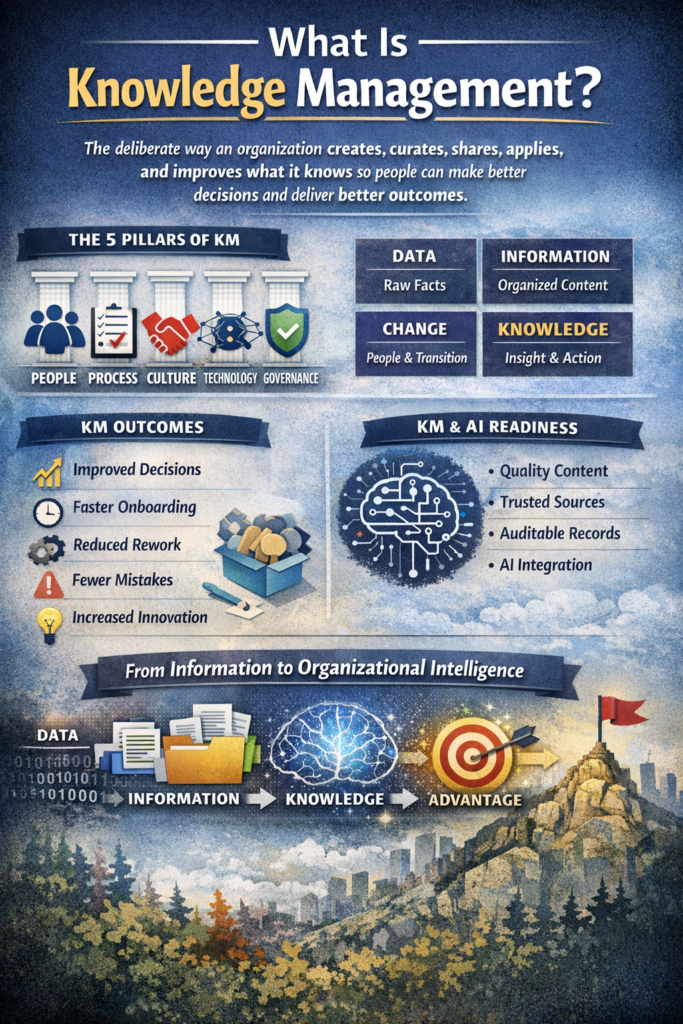
Knowledge Management is the deliberate way an organization creates, curates, shares, applies, and improves what it knows so people can make better decisions and deliver better outcomes.
That is the difference between storing information and operating with organizational intelligence.
The Five Pillars of Knowledge Management
Many KM frameworks exist. However, successful programs usually depend on the same core conditions. In practice, five pillars must reinforce one another.
1. People
Knowledge Management starts and ends with people. Tools can support knowledge work, but people create meaning and apply experience.
Strong KM environments make it easier for people to:
- Ask questions without fear.
- Share lessons without blame.
- Teach others without losing status.
- Challenge assumptions with respect.
- Build trusted networks across teams.
Therefore, knowledge sharing cannot depend on a few volunteers. Leaders should make it part of normal work, expectations, and incentives.
2. Process
Sustainable KM uses repeatable processes that fit the operating rhythm. These processes should reduce friction rather than add bureaucracy.
For example, effective practices include:
- After Action Reviews that lead to real changes.
- Peer Assists before major work begins.
- Communities of Practice that solve recurring problems.
- Structured onboarding that reduces time to proficiency.
- Knowledge transfer for critical roles and transitions.
If an organization captures lessons but never changes practice, it has reporting rather than learning. A strong lessons learned system closes that loop.
3. Organizational Culture
Culture determines whether people actually use KM practices. Where leaders reward openness and learning, KM can grow. Where people gain status by hoarding knowledge, KM becomes a compliance exercise.
Strong knowledge cultures usually include:
- Trust and psychological safety.
- Leaders who ask what was learned and reused.
- A belief that knowledge is an organizational asset.
- A preference for evidence and continuous improvement.
Most importantly, culture becomes visible when deadlines tighten or mistakes occur. What leaders reward at those moments matters more than a slogan.
4. Tools and Technology
Technology enables Knowledge Management, but it does not create KM by itself. SharePoint, ServiceNow, Confluence, enterprise search, and AI can all help. However, weak governance or poor processes can turn any platform into an expensive filing cabinet.
Useful KM technology makes knowledge:
- Findable: people can locate the best available answer quickly.
- Usable: content supports action rather than storage alone.
- Trusted: ownership, quality, and currency are clear.
- Embedded: knowledge appears where work and decisions happen.
As a result, users spend less time searching and more time applying what the organization already knows.
5. Governance
Governance makes Knowledge Management durable. It creates clarity about ownership, standards, quality, access, and accountability.
Good governance answers practical questions:
- Who owns each critical knowledge domain?
- Which sources are authoritative?
- How is knowledge reviewed and kept current?
- How are access, privacy, and security managed?
- Which taxonomy and metadata standards apply?
- How does KM support mission and business outcomes?
Without governance, well-intentioned KM efforts often drift or duplicate. With clear KM strategy and governance, teams can sustain useful knowledge over time.
Knowledge Management Versus Data, Information, and Change Management
Organizations often blur several related disciplines. Each one matters, but each serves a different purpose.
- Data Management governs raw data, definitions, lineage, quality, and stewardship.
- Information Management organizes documents, records, content, and retrieval.
- Change Management helps people adopt and sustain new ways of working.
- Knowledge Management connects people, process, culture, technology, and governance so experience becomes useful action.
A practical way to view the relationship is:
Data becomes information when context is added.
Information becomes knowledge when people interpret and apply it.
Knowledge creates advantage when it improves decisions and outcomes.
For example, a platform can manage documents well. KM adds learning processes, trusted expertise, Communities of Practice, and governance that keep the content useful.
The Knowledge Management Outcomes Leaders Care About
KM should not be judged only by uploads, page views, or repository size. Those measures show activity, not business value.
Instead, leaders should look for outcomes such as:
- Faster onboarding and time to proficiency.
- Fewer repeated incidents and preventable failures.
- More reuse of proven practices.
- Less rework and duplicated effort.
- Better decisions supported by evidence and context.
- Greater resilience during turnover or restructuring.
- More innovation through stronger expert networks.
Therefore, KM should connect directly to the organization’s priorities. If it cannot show that connection, the program will remain vulnerable.
Knowledge Management in the Age of AI
Artificial Intelligence raises the importance of Knowledge Management. AI can scale access to useful knowledge, but it can also scale weak knowledge quickly.
If content is outdated, duplicated, poorly governed, or hard to trace, AI inherits those weaknesses. For that reason, AI readiness depends heavily on the knowledge foundation.
Modern KM should support:
- Answers grounded in authoritative sources.
- Clear ownership and content lifecycle management.
- Quality controls and regular review.
- Taxonomy and metadata that improve retrieval.
- Decision records that preserve context and rationale.
- Human validation for high-impact knowledge use.
In short, AI does not replace KM. It makes disciplined KM more important. Organizations can start by reviewing their KM and AI readiness.
Where to Start
Knowledge Management is not a one-time initiative. It is an organizational capability that grows through practice, leadership, governance, and disciplined execution.
If your organization wants to move beyond storing information, begin with the business outcome or knowledge risk you need to address. Then assess the current capability and build the right sequence of interventions.
Knoco International supports organizations through KM assessment and benchmarking, strategy, implementation, learning, retention, Communities of Practice, and AI readiness.